
AI skills you can show, not just list.
Start any time. Lessons online, build days in person every Monday and Tuesday (and on Zoom), and Demo Day every Thursday evening, where everyone comes to show their build.
Learn online. Come for the community.
"Familiar with AI tools" is on every resume now. A working system you built is not. In six weeks you build one in every lesson: a deployed project, an automation, a chatbot that answers from real documents, a voice agent, a test that proves an agent works. You finish with a portfolio you can open in an interview and explain.
We teach and we check your work. We do not place people in jobs, and we will not promise you one.
Start any time. Build with us every week.
Next build day: Start any time. Build days every Monday and Tuesday. · for all six weeks, everything included The current price is listed at hub.aistartacademy.com/cohorts/next.
Learn online. Come for the community.
6 weeks · 6 modules · 25 workbook chapters · lessons online · build days Monday and Tuesday · Demo Day every Thursday evening in San Francisco
A portfolio of things that run.
Every lesson ends with a hands-on task that you submit for automatic feedback. Nothing here is a slide deck or a multiple-choice score. By the end of week 6 you have built:
- A task audit. The HAS Audit: a method for deciding which work AI should take and which it should not. You can walk someone through it on their own team's week.
- A deployed project. Built with Claude Code and live at a real address you can send as a link.
- An automation in n8n. A workflow that starts on a trigger and finishes without a person pressing go.
- A chatbot built on RAG. It answers from a set of documents instead of making things up.
- A voice agent. Built with Vapi, ElevenLabs and Twilio, able to hold a phone conversation.
- A security review of your own agents. What they can see, what they can do, where they could be misused.
- An eval. A test for an AI system, so "it works" is a number and not an opinion.
- A content pipeline and a digital avatar.
- A scoped and priced automation proposal. More on why that matters for a job search in section 5.
What that gives you in practice: something concrete to show and talk about, and hands-on time with the tools by name: Claude Code, n8n, MCP, RAG, Vapi, ElevenLabs, Twilio, OpenClaw.
Read this before you pay.
What is true:
- You build a working system in every lesson, and you keep everything you build.
- You get automatic feedback on each piece of work. It is guidance, not a grade, and it never blocks your progress.
- You get practical skill with the tools named on this page.
- You are part of a group that starts with you, with live calls every week.
What we do not do:
- We do not place people in jobs.
- We do not promise interviews, offers or a pay level.
- We do not run a job-search service. No resume writing, no recruiter introductions, no interview coaching.
- We do not have a separate career track. Everyone takes the same six modules.
Whether this helps you get hired depends on the role you are after, your background, and what you do with the work you built. If someone tells you a six-week course will get you a job, be careful with them.
Six weeks, six modules, and what you build in each.
The curriculum is the AI Automation Agency Bootcamp. Pick a module to see its workbook chapters, what you build, and a clip from the lecture.
Prompt attention strategy · a short cut from the prompting lecture, from the AISA YouTube channel.
Claude Code and a personal Life OS vs Codex · a recorded live session, from the AISA YouTube channel.
AI agent: end-to-end automation · a short cut from the agents lecture, from the AISA YouTube channel.
Your personal deployed AI voice agent · a short cut from the voice lecture, from the AISA YouTube channel.
Personal AI infrastructure: knowledge graphs and memory · a recorded live session, from the AISA YouTube channel.
AI avatars created by our students · a short cut from the avatars lecture, from the AISA YouTube channel.
Watch. Build. Show.
Watch.
Watch short video lessons, each following a chapter of the AISA Bootcamp Workbook, which you get with your seat. All six modules are open to you.
Build.
Complete a hands-on task, a quiz, and a submission that gets automatic feedback. It is guidance. It is not a grade and it never blocks you from the next lesson.
Show.
Bring what you built to a build day every Monday and Tuesday at 1769 15th Street, San Francisco or on Zoom, then demo it at Demo Day on Thursday evening. Request a 1:1 session with a mentor if you get stuck anywhere.
What a lesson looks like
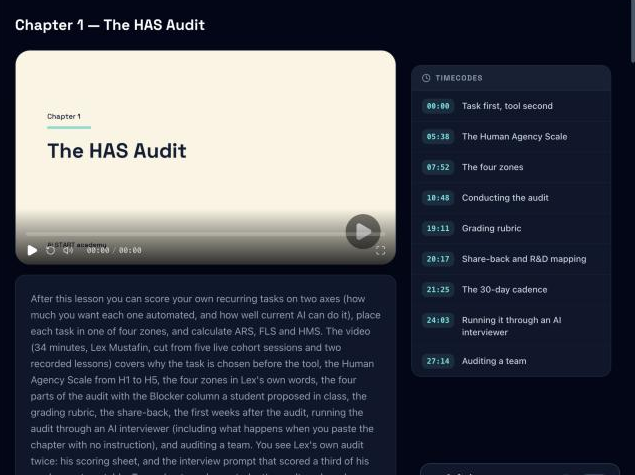
I want to learn the HAS Audit (Human Agency Scale Audit), a way to choose which tasks in my week to hand to AI and which to keep human. First, ask me in one message what my business or job is and which 3 tasks take most of my week. Wait for my answer. Then explain these ideas in plain language, using only my 3 tasks as examples:
1. The Human Agency Scale, from H1 (Full Automation) to H5 (Human Essential). Make clear it measures how much I WANT a person involved, not what AI CAN do.
2. The four zones from crossing my desire with AI capability: Green Light, R&D Opportunity, Red Light, Low Priority.
3. Why the task gets chosen before the tool.
End with 3 short questions that check whether I understood. Do not answer them for me.
Every lesson has prompts like this one. You paste them into Claude or ChatGPT, do the task on your own example, then submit the result to Check my work for feedback in minutes.
- Watch A short video, cut from the live lectures.
- Read The matching chapter of the AISA Bootcamp Workbook.
- Follow The prompts and the task on your own laptop.
- Check my work Submit it and get feedback. Guidance, not a grade.
Week 6 is the agency module. Here is why it is still worth your time.
The program is called the AI Automation Agency Bootcamp, and the final module is about launching an agency. Everyone takes it. We are not going to rename it to make it sound like career coaching.
Here is the honest case for it. In that module you take an automation you built and answer four questions: who is it for, what does it replace, what does it take to deliver, and what is it worth. That is how an agency writes an offer. It is also how you explain your value to an employer: not "I know n8n" but "this task took a team this many hours, here is the system that does it, here is how I tested it, here is what it costs to run."
You will also learn to publish work so it can be found, which is useful for anyone who wants their projects seen.
If the agency part is of no interest to you at all, weeks 1 through 5 are still the bulk of the building.
Start any time. Build with us every week.
Lessons on your own time. They are online. Do them in the morning, late at night, or between interviews.
Build days every Monday and Tuesday. Work on your own project with instructors in the room at 1769 15th Street, San Francisco, or join on Zoom.
Demo Day, Thursday evening. Students and graduates demo what they built at the school and on Zoom.
You will not be doing this alone in a browser tab.
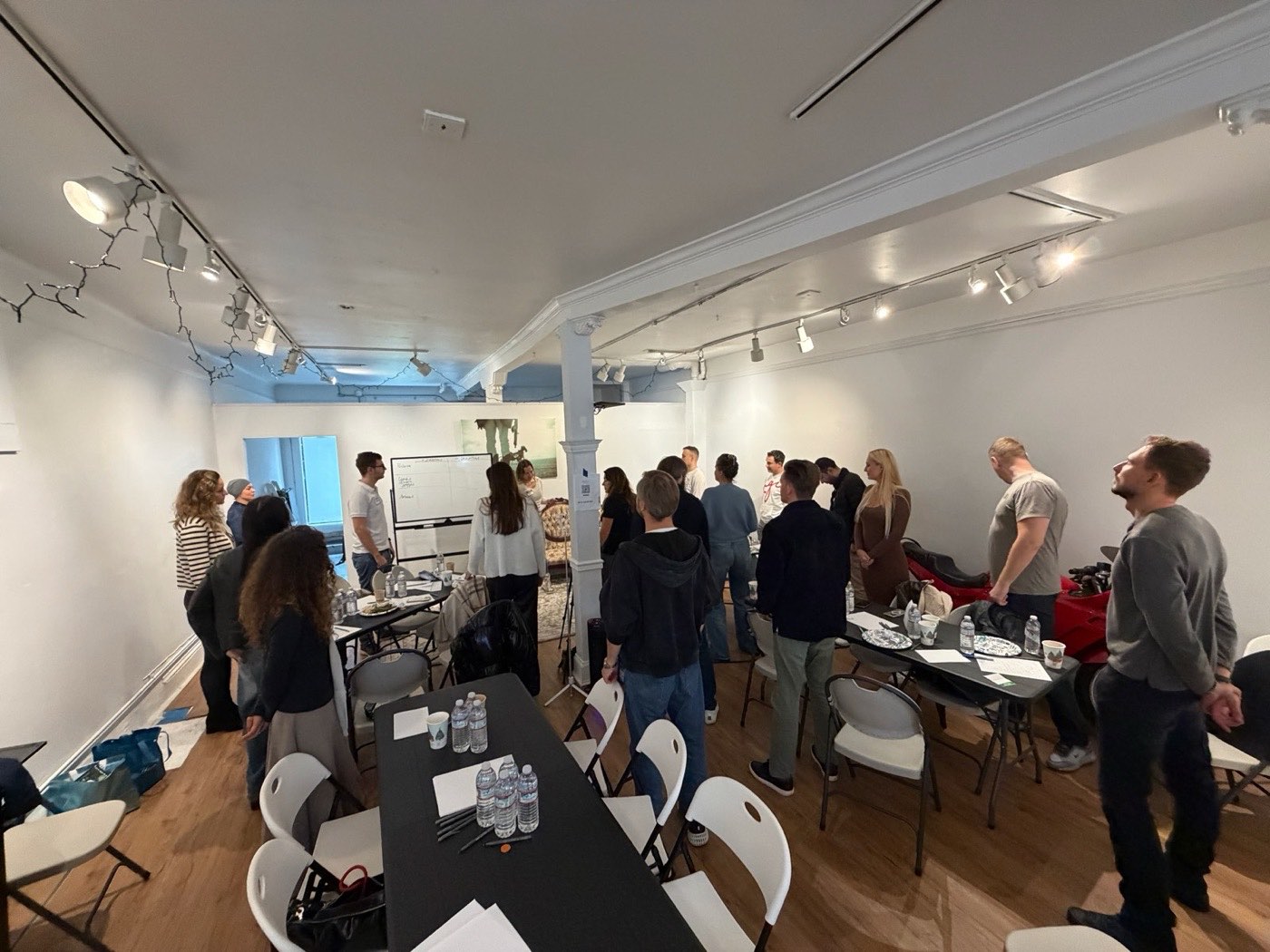
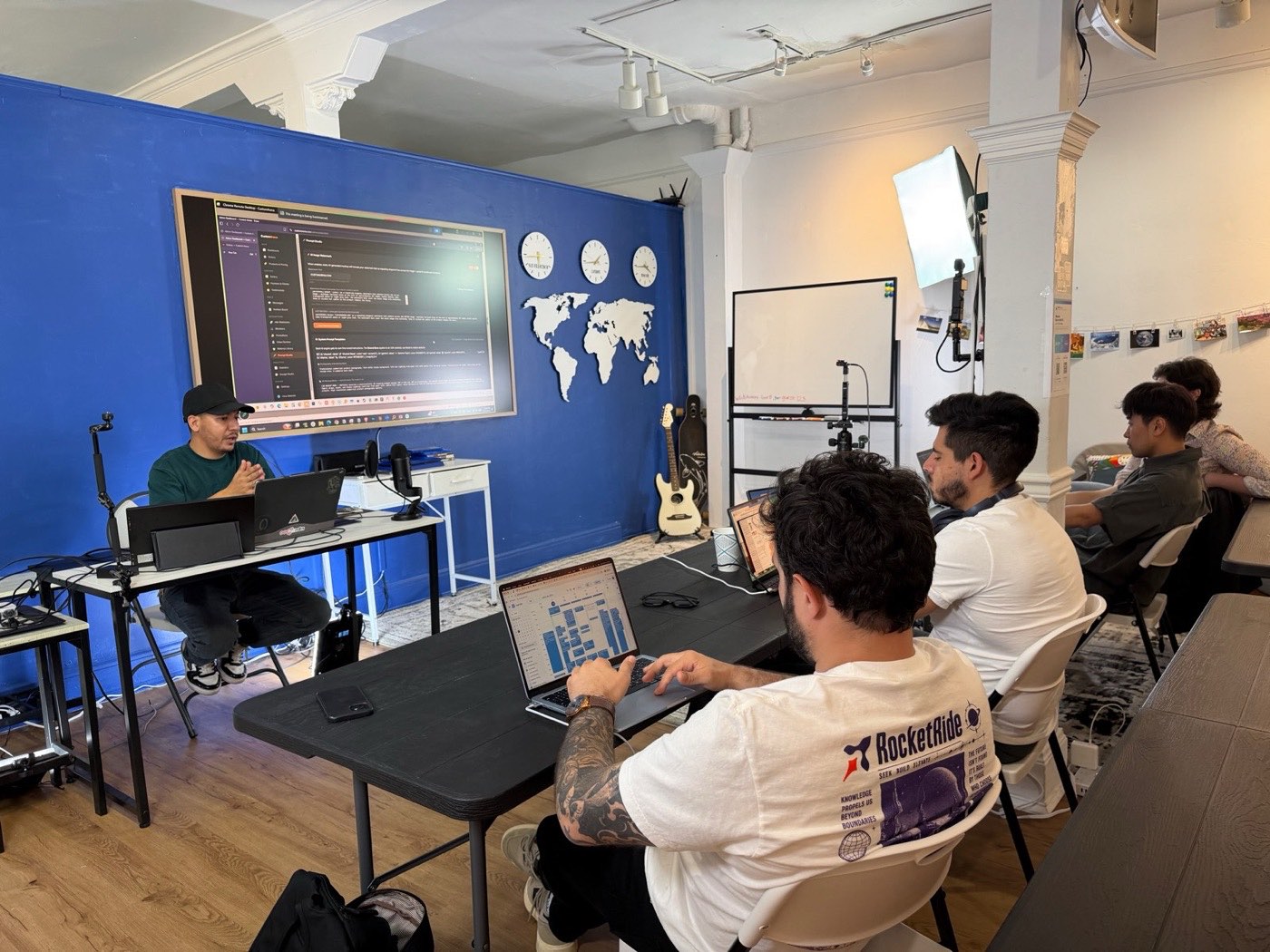
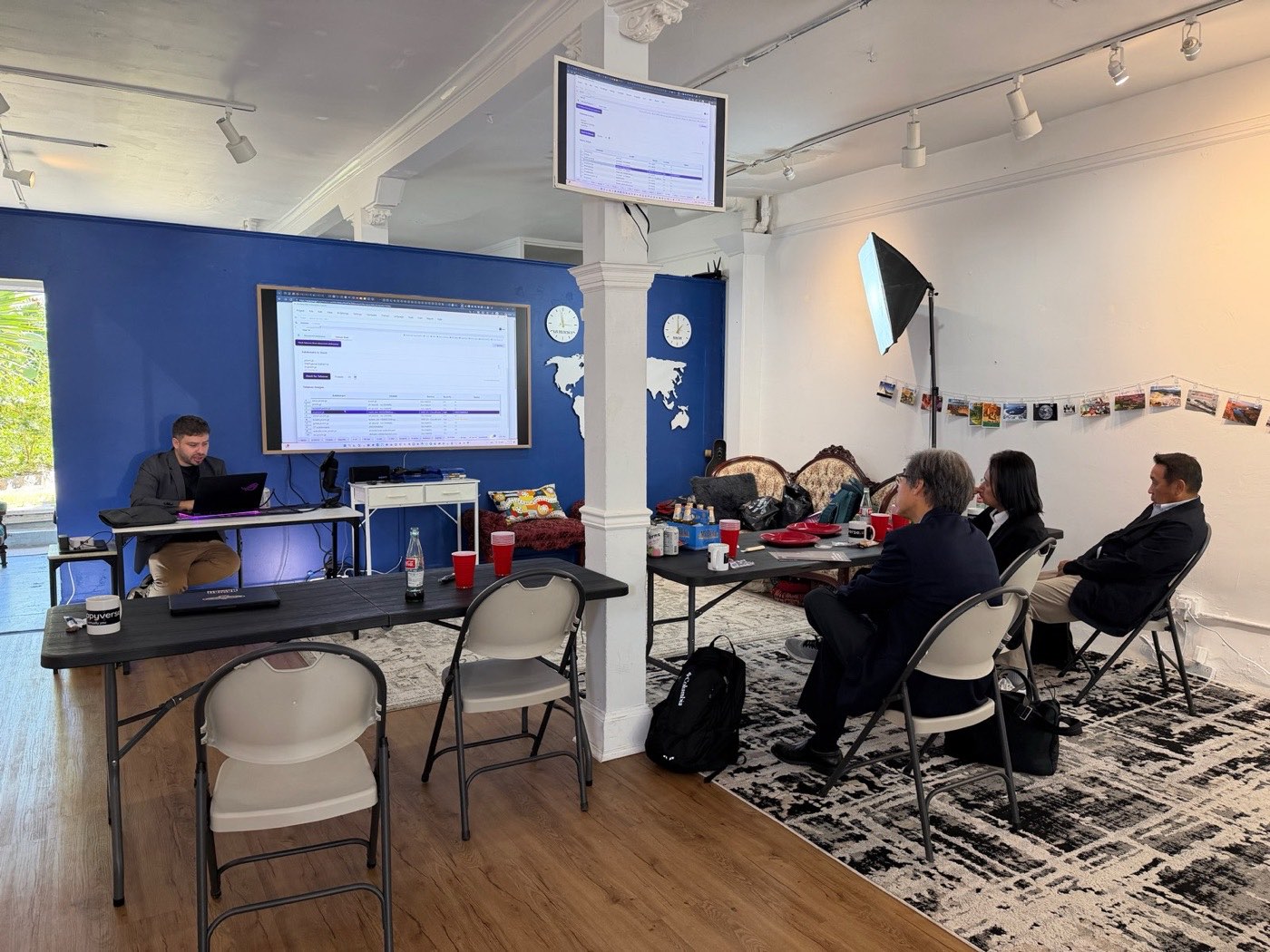
Build days, Monday and Tuesday. Work on your own project with instructors at the tables. People one week in and people five weeks in build in the same room.
Demo Day, Thursday evening. Students and graduates demo what they built at the AI Automation Agency Founder Meetup.
Online, if you are not in the Bay Area. Build days and Demo Day on Thursday evening are also on Zoom. The school is at 1769 15th Street, San Francisco, in the Mission, about five minutes from 16th St BART.
Your week, every week.
Start on any Monday. From then on the week has the same shape, for everyone in the building and on Zoom.
Monday
Start.
The group that starts this week meets for the first time: set up your laptop, open Module 1, meet the people you will build beside for six weeks. Already running? Monday is a build day for you.
Tuesday
Build.
Instructors at the tables, in person and on Zoom. Every Tuesday has a build on the board, and you work on the one for the week you are in:
- Week 1. Your HAS Audit and a system prompt that does one task the same way every time.
- Week 2. A project made with Claude Code, deployed to a live address, and your first MCP connection.
- Week 3. An n8n workflow on a trigger, an agent that uses tools, and a chatbot that answers from your documents.
- Week 4. A voice agent that holds a phone call and a private AI setup with OpenClaw.
- Week 5. An eval for one of your agents and a memory layer it can read and write.
- Week 6. A digital avatar, a content pipeline, and your written agency offer.
Thursday evening
Demo Day.
Everyone comes to show their build. Students one week in, students five weeks in, graduates, and anyone curious about the school.
Your group, your certificate. You go through the six weeks with the people who started the same Monday as you. At the end, every member of the group receives a certificate from AI START academy with a verification link, ready to add to your LinkedIn profile.
What students say.
In their own words
13 student videos from the channel · swipe to see more →
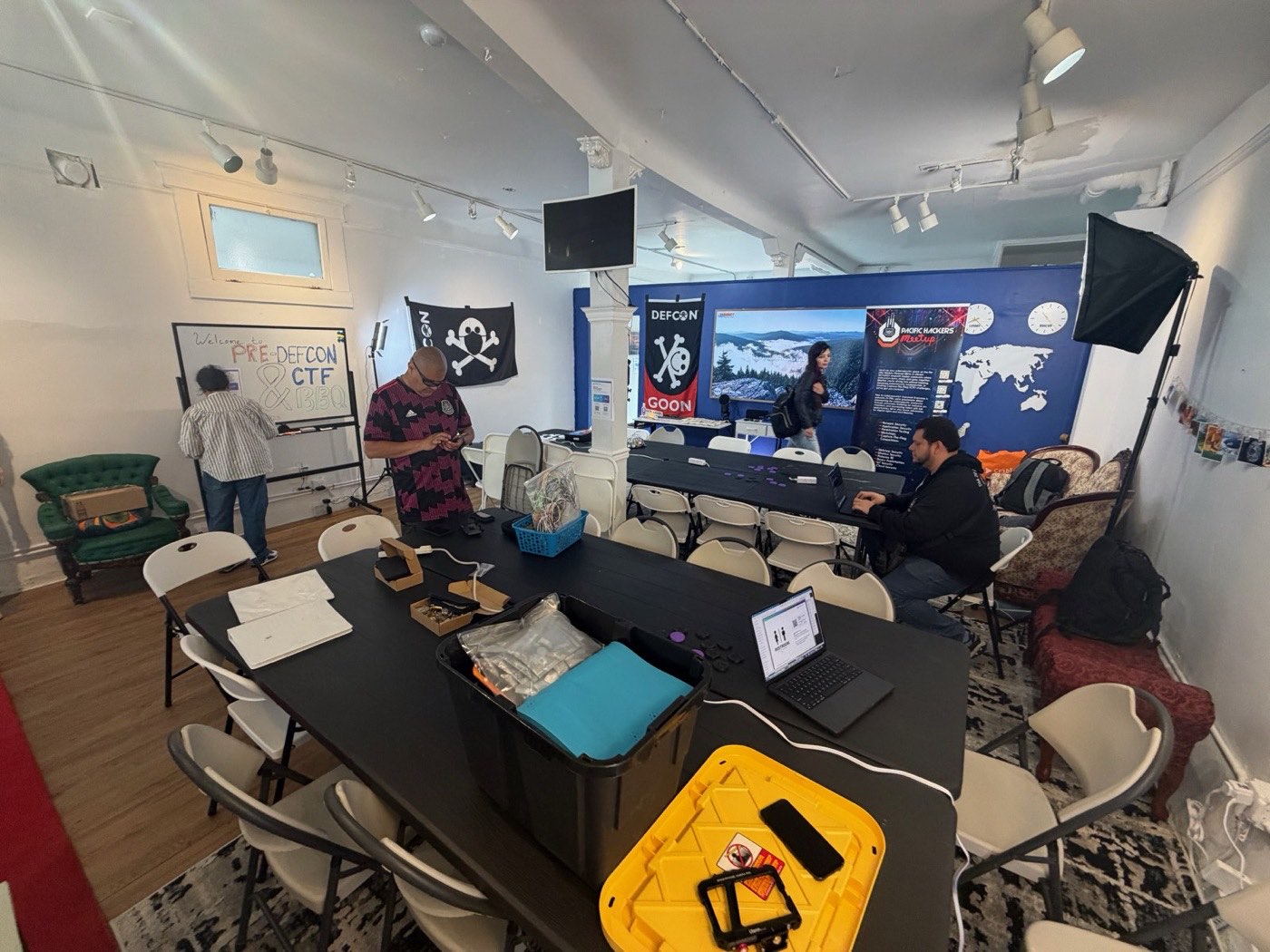
A real room in the Mission.
Build days and Demo Day happen in person at the school, five minutes from 16th St BART, and on Zoom for everyone else. Come once and you will know whether it is for you.
Visit us
1769 15th Street, San Francisco, CA 94103
Public transit: BART 16th St Mission
Parking: closest is ELIF Parking
Open in Google MapsWhen the room is open to you
- Build days, every Monday and Tuesday
- Demo Day, every Thursday evening
- Everything also on Zoom
Instructors who work with these tools.
Lex Mustafin, founder of AI START academy. Foundations, Claude Code, deployment, content and agency launch. Lex came to the United States with a translation degree, taught himself to code, built and sold a startup that went through the 500 accelerator, and mentors founders at 500 Global and Draper University.
Bogdan Red, CTO at CQR Cybersecurity. Security and OpenClaw.
Kheir Lazaref. n8n and voice agents: Vapi, ElevenLabs, Twilio.
This is the wrong program if:
- You need a job promise. We don't offer one, and we don't place people in jobs.
- You want a specific technical career such as cloud security, machine-learning engineering or backend software engineering. This program teaches you to deploy AI automations for a business. It does not teach you to train or fine-tune models.
- You want help with the job search itself. We teach building. We do not do resumes, introductions or interview prep.
- You want videos only. The self-paced course on the hub fits better: https://hub.aistartacademy.com/self-paced
Questions we hear from people changing careers.
"I'm working shifts. I can't make a class."
There is no class to make. Lessons are online and you do them when you can. Start any time, then join build days every Monday and Tuesday when they fit.
"I'd miss a week in the middle and have to start over."
There is no class night to miss. All six modules stay open, so continue when your schedule clears and return to a build day.
"I've never coded. Is this too technical for me?"
No coding background is needed. Week 1 starts from zero, and when you reach the terminal and Claude Code in week 2 the lessons walk you through it.
"I thought this would be more technical."
Then it may not be for you. This is applied work: building and deploying agents, automations and voice systems for a business. It is not a computer science or machine-learning course.
"Will this get me a job?"
We can't tell you that, and we won't pretend to. What we can tell you is what you leave with: a set of working systems you built and can demonstrate, and real practice with the tools. We do not place people in jobs.
"How do I know the school is real?"
Look first. The YouTube channel has real footage of sessions: https://www.youtube.com/@aistartacademy. You can request a call with our team from this page.
"I don't learn well staring at a screen."
The lessons are short videos followed by a task you do yourself, so most of your time is spent building. Come to the room in San Francisco on Monday or Tuesday, then see students demo their work at Demo Day on Thursday evening.
"Is the price per class?"
No. covers all six weeks, everything included. It is not per class.The price covers all six weeks, everything included. It is not per class.
"I can learn this free on YouTube."
You can find the information there. What you won't find is a set order, a task at the end of every lesson that gets checked, build days, and a group that meets every week. A portfolio comes from finished work, and finishing is easier with structure.
One seat, six weeks.
The current price is listed at hub.aistartacademy.com/cohorts/next.
The price covers all six weeks, everything included. It is not per class.
What your seat includes:
- all six modules
- the AISA Bootcamp Workbook, with every lesson following a chapter
- the checked tasks
- a 1:1 session with a mentor whenever you get stuck; request one any time
- build days every Monday and Tuesday
- Demo Day on Thursday evening
- Zoom access to both
Next build day: Start any time. Build days every Monday and Tuesday.
Want to look around first?
Leave your email and we will send you the Modern AI Thesaurus, our free guide to the AI terms and tools you will see in job descriptions and in the bootcamp, plus news from the school.
Send it to meAI skills for a new job: questions and answers
- No. AI START academy does not place people in jobs and does not promise interviews or offers. The program teaches you to build working AI systems, and you keep what you build.
- A portfolio of systems you built yourself: a project deployed with Claude Code, an n8n automation, a RAG chatbot, a voice agent, a security review, an eval, and a scoped automation proposal.
- The program covers Claude Code, n8n, MCP, RAG, voice agents with Vapi, ElevenLabs and Twilio, OpenClaw for private AI, evals, and digital avatars.
- No. Every student takes the same six modules, including the agency launch module in week 6.
- In the agency module you scope and price an automation you built. Describing who a system is for, what it replaces and what it is worth is also how you explain your value to an employer.
- No. The program does not require a coding background, and the lessons start from the basics.
- Six weeks. All six modules are open to you from day one, and you can start any time.
- Yes. Every student gets the AISA Bootcamp Workbook, and every lesson follows a chapter of it. Read along, follow the steps, and keep it as a reference after the program.
- Request a 1:1 session with a mentor if you get stuck anywhere. You can also bring the problem to a Monday or Tuesday build day.
- Yes. Lessons are online on your own schedule. Build days run every Monday and Tuesday in San Francisco and on Zoom.
- No. It teaches you to build and deploy AI automations and agents for a business. It does not teach model training, machine-learning engineering or cloud security as a career track.
- The price covers all six weeks, everything included. It is not per class. The current price is listed at hub.aistartacademy.com/cohorts/next.
- AI START academy is at 1769 15th Street, San Francisco, in the Mission District, about five minutes from 16th St BART. Build days and Demo Day on Thursday evening are held there and on Zoom.
- The live calls are recorded and students get the recordings. You can keep working through the online lessons and join the next build day or Demo Day on Thursday evening.
- Yes. If the Weekly Cohort is not for you, email hello@aistartacademy.com and we refund you, no questions asked.
- Yes. Email hello@aistartacademy.com and we set up an individual payment plan for you.
- Yes. Students who complete the Weekly Cohort receive a certificate from AI START academy.
- Yes. Email hello@aistartacademy.com and tell us honestly where you are at.
- Keep going when your schedule clears. All six modules stay open to you, and you can return to the Monday and Tuesday build days any week.
- Students and graduates demo what they built at the AI Automation Agency Founder Meetup. Join at the school or on Zoom.
Start any time. Build with us every week.
. Start any time. Build days every Monday and Tuesday. Six weeks later you will have a set of working AI systems with your name on them. What you do with them is up to you, and we will be straight with you about that the whole way through.
Learn online. Come for the community.